
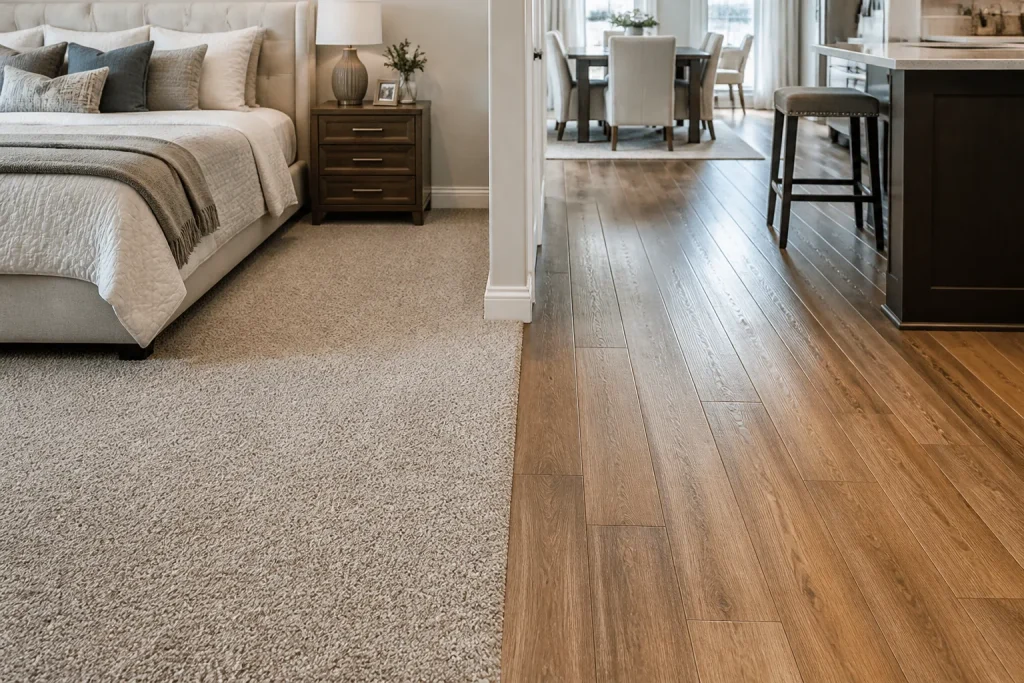
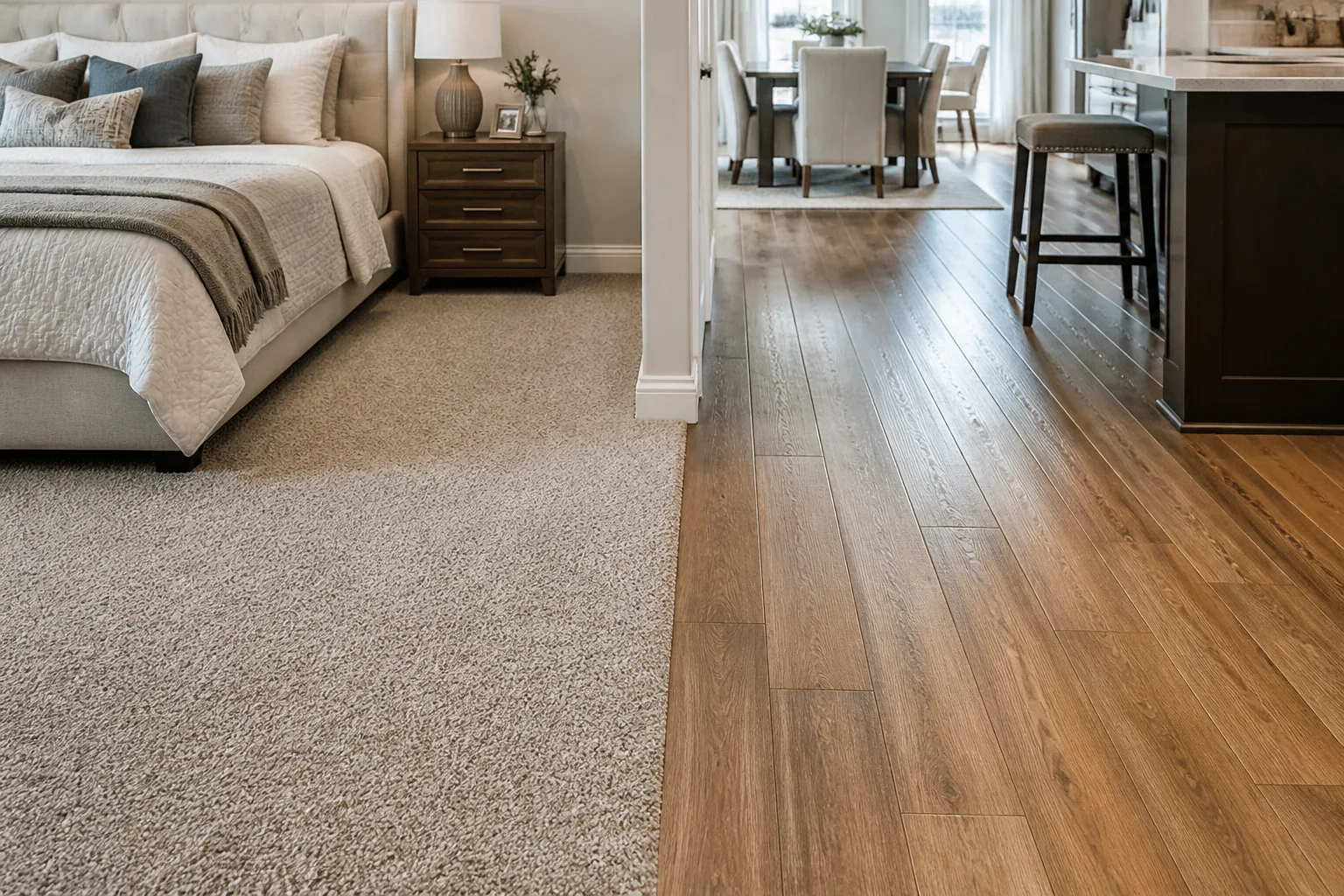
Carpet or Hard Flooring for a Bedroom: How to Decide
Most people decide this one on feel. They walk into a bedroom, picture their feet on a soft surface, and pick carpet. Or they picture a clean, open room and pick hard flooring. Both instincts are valid, but neither holds up over a decade of real use. The bedroom is the lowest-traffic room in the house and the one where sound, temperature, and sleep matter most. That flips the usual advice. This guide breaks the choice down by function first, then material, so you end up with a floor that still makes sense long after the honeymoon phase.
If you’d rather not wrestle with this alone, call (844) 651-6528. We answer 24/7, and dispatch runs 7am to 7pm, Sunday through Friday.
Start With Sleep, Not Style
The single biggest factor people ignore is how the room sounds. Carpet reduces impact noise by roughly 25 to 34 dB compared to hard flooring. That number matters more than any color swatch if you live in a multi-story home, have kids who wake early, or share a house with someone on a different sleep schedule. A hard floor turns every footstep, dropped phone, and dresser drawer into a small event. Carpet absorbs it.
Here’s a quick filter to help you decide before you shop:
- Multiple sleepers, staggered schedules, or a second story? Carpet wins on acoustics almost every time.
- Single-story home, one occupant, no one below? Hard flooring’s benefits get stronger.
- Pets in the bedroom? A hard surface cleans faster; carpet needs the right maintenance routine.
- Allergies in the household? Read the next section before you assume the answer.
We bring this up early because it’s the factor most people only notice after installation. In our experience, the customers who regret a bedroom floor are almost always the ones who picked on looks and didn’t think about sound until the first week of living on it.
The Allergen Question: What the Evidence Actually Says
You’ve probably heard that carpet is worse for allergy sufferers than hard floors. The reality is more nuanced. Indoor air quality research has shown that carpet fibers trap particulates at floor level rather than letting them recirculate into the air you breathe. The problem isn’t the material. The problem is maintenance frequency and equipment quality.
So what does that mean in practice?
- The variable is cleaning cadence. A hard floor that gets swept once a week and mopped rarely can hold more fine dust in the air than a carpet that’s vacuumed properly twice weekly.
- Filtration matters. Carpet performs well for allergy households when it’s vacuumed with a HEPA-filtered machine, not a basic upright that stirs dust back up.
- Matte and pile matter. Lower-pile and tightly woven carpets release debris to the vacuum more easily than deep shag, so they’re a more practical choice if allergies are a concern.
We don’t sell air purifiers, and we won’t pretend carpet is a health product. But the “carpet is bad for allergies” line is a simplification that’s cost plenty of people a floor they’d have loved. If you want brand-level performance with deep pile options, Shaw and Mohawk both make carpet lines that hold up in real households. If you want the hard-surface route with maximum cleanability, a carpet installation consultation is actually the right first call – it lets you compare materials and pile heights side by side before you commit.
Thermal Comfort in a Desert Climate
This part gets skipped in most carpet-versus-hardwood articles, and it’s the biggest reason we bring it up for Paradise. Many homes here are slab-on-grade, and concrete holds overnight cold well into the morning. If you’re stepping onto a bare tile or concrete-adjacent floor at 6am, that’s a cold shock you feel every single day. Carpet provides a genuine insulation layer that a hard floor over an unconditioned slab doesn’t.
What this looks like in a Paradise bedroom:
- Carpet or carpet with a thermal pad gives you the warmest morning floor without heating the room.
- Tile or LVP over concrete will feel cold for months of the year unless the slab is conditioned or you add area rugs.
- Hardwood sits warmer than tile but colder than carpet, and it responds to indoor humidity swings, which is worth planning around.
If you’re doing a whole-home project anyway, this is where a single installer across every surface helps. Our Paradise Flooring Installation team handles carpet, tile, and hardwood refinishing so you’re not coordinating three contractors and hoping they agree on sequencing.
Long-Term Cost: Why Bedrooms Are Different
Whole-home averages mislead you on bedrooms. Bedrooms receive the lowest foot traffic of any room in the house – no shoes traversing them daily, no kitchen traffic, no entryway grit. That means a carpet’s wear timeline in a bedroom runs substantially longer than the same carpet would in a hallway or living room. The material that dies first in your living room can hold its own in a bedroom for far longer.
Hard flooring is a bigger upfront spend, but it doesn’t have the replacement cycle that carpet does. Here’s the honest framing:
- Carpet: lower entry cost, softer underfoot, warmer, quieter – and it will eventually need replacing.
- Hard flooring: higher upfront, easier to clean, immune to the pile-crushing and stain issues – and it stays put if the subfloor is sound.
- Hardwood refinishing: if you already have original wood under carpet in an older home, the restore-don’t-replace path often costs less than new flooring and keeps the character of the room.
We can’t quote a real number until we’ve seen the room, which is why the estimate has to come from a visit, not a phone call. If you already have wood you’re thinking about refinishing, don’t pull the trigger until a pro confirms the wear layer thickness and condition – not every floor can be refinished.
The Hybrid Solution: Honest Reality Check
Area rugs over hard flooring are often presented as the compromise that gets you both worlds. And they work – mostly. But they come with two problems the typical article leaves out.
First, slip. A rug over a finished hard floor can shift, especially in a bedroom where people step on and off the bed barefoot. A proper rug pad helps, but you’re still managing an object that moves. Second, seams. A wall-to-wall carpet has no edges to catch, no corners to lift, and no crumb trap where rug meets floor. An area rug absorbs all of that. It’s one more thing to straighten every time you vacuum.
None of that makes area rugs a bad choice – they’re genuinely good for renters, or for a bedroom where you want to swap styles without redoing the floor. But if you’re going to install hard flooring anyway and your main motivation for the rug is comfort, walk into that decision with your eyes open. Wall-to-wall carpet exists because it solves these problems in one move. For premium design-led vinyl under a rug, Karndean is a strong option that pairs well with area pieces, and COREtec is a water-resistant plank line that’s worth exploring if durability underfoot matters most.
When to Call a Pro
Honestly, most bedroom floor projects end up here. Not because the work is dangerous, but because the variables multiply fast: subfloor condition, moisture, transition strips at doorways, stair transitions, closet edges, and whether the existing carpet pad needs replacing. A trained crew catches all of that at the estimate visit, before anything is ordered.
For multi-story homes, our technicians have up to 11 years of experience and understand that bedroom carpet noise reduction is only as good as the underlayment and installation. For bedrooms where hard flooring is winning, a proper tile flooring installation with correct subfloor prep is the difference between a floor that lasts and one that cracks at the first seasonal swing.
A quick check on whether it’s time to call:
- The existing floor has soft spots, lifted edges, or visible moisture staining.
- You’re deciding between refinishing existing hardwood and starting fresh.
- You want a specific brand (Shaw, Mohawk, COREtec, Mannington, and Karndean are all in the portfolio we install) and need to see what’s viable for your room.
- You’re doing more than one bedroom and want consistency across the whole floor plan.
Related services in Paradise: bedroom carpet, tile, and hardwood refinishing are all handled under one team – see the full lineup on our homepage.
The Bottom Line
For most bedrooms in Paradise, the answer lands in one of three places. If sound, warmth, and lower upfront cost matter most, carpet wins – especially in multi-story homes and slab-on-grade construction. If ease of cleaning and long-term durability are the priority, hard flooring wins, provided the subfloor is prepped correctly. If you already have original hardwood under the carpet, ask about refinishing before you demo. The room doesn’t lie: think about how you actually use it, what time you wake up, and how much noise you’re willing to absorb.
If you’re in Paradise and want help deciding, our team offers free estimates with upfront pricing and a written quote before anything gets ordered. Call (844) 651-6528. We answer 24/7, and fast dispatch runs from 7am to 7pm, Sunday through Friday.
Frequently Asked Questions
Carpet is significantly quieter – it reduces impact noise by roughly 25 to 34 dB compared to hard flooring. That’s the single biggest acoustic difference between the two, and it matters most in multi-story homes or households with staggered sleep schedules. If you want hard flooring but need quiet, plan on underlayment and an area rug.
Not inherently. Research on indoor air quality has shown that carpet traps particulates at floor level rather than recirculating them. The practical variable is cleaning – carpet needs regular vacuuming with a HEPA-filtered machine to perform well for allergy households, and hard flooring needs regular mopping to avoid pushing fine dust back into the air. Call (844) 651-6528 for a free estimate if you want to compare specific carpet lines side by side.
Because the carpet, pad, and air gap together act as an insulation layer over a slab-on-grade floor. Concrete holds overnight cold for hours, and bare tile or LVP transmits that cold straight to your feet in the morning. Carpet breaks that transfer. Hard flooring over an unconditioned slab will feel colder for more of the year unless you add rugs or condition the space.
You get most of the comfort and some of the acoustic benefit, but not all of it. Area rugs shift, need a rug pad to stay put, and add seams and edges that collect crumbs – none of which a wall-to-wall carpet has. For bedrooms where you want the option to swap styles later, an area rug is a reasonable solution. For a permanent installation, wall-to-wall carpet remains the cleaner answer.
Written by the team at Paradise Flooring Installation.
Need Flooring Help?
Call Paradise Flooring Installation - licensed & insured, with free written estimates in Paradise.
(844) 651-6528